
Environmental pollution
The greatest opportunity to reduce waste and thus pollution is to ensure that the right amount of material is used in the network expansion with as little waste as possible.
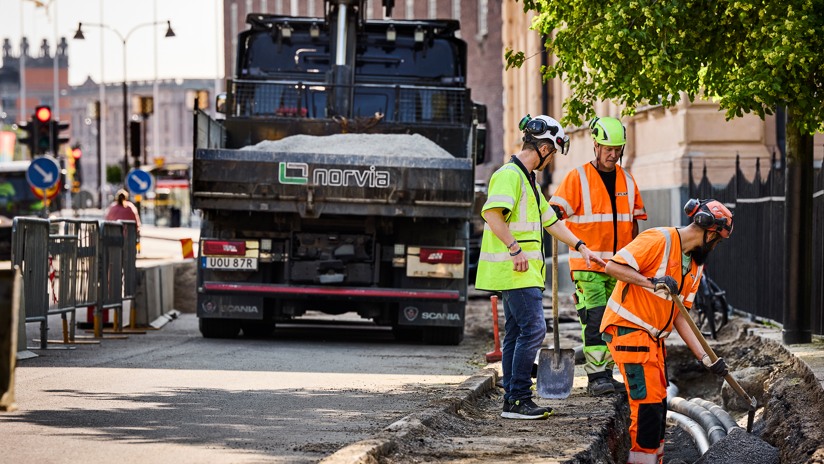
Recycling waste and residual materials
Waste and residual materials arise at various stages of the production chain that Stokab relies on to deliver its fibre-optic network. To minimise waste, which can lead to increased incineration and pollution, material requirements are carefully calculated for each project. In connection with framework procurement agreements, we set requirements for our contractors’ waste management in accordance with the EU waste hierarchy.
To identify and reduce environmental impact in major deployment projects, the responsible contractor is required to submit environmental and waste management plans. In planning projects where there may be an impact on biodiversity, the County Administrative Board must be provided with certain documentation in order for the project to proceed. One of the documents that may be required for activities such as water-related operations is an environmental impact statement (EIS).
Management of excavated material
The City of Stockholm’s Environmental Programme 2030 states that the management of excavated material is an important part of achieving the goal of “A resource-efficient and circular Stockholm”. Stokab is involved in the City’s work on the management of excavated material. By enabling efficient logistics for excavated material and construction waste, as well as the reuse of these materials, a significant number of transport movements can be avoided and the extraction of virgin materials reduced². Stokab expects to be able to increase the local reuse of excavated material where it has been confirmed that it does not contain contaminated material. In addition, there will be an opportunity to use the excavated material logistics centres established in the City.